
Smart home technology has moved from a futuristic luxury to an everyday household staple. From energy efficient heating systems to voice-controlled lighting, connected devices are making modern living easier, safer and more sustainable.
Our latest research shows that almost two-thirds (62%) of people in the UK believe that smart home technology will become essential in every household within the next five years.
We’ve explored what this means for homeowners across the country: which smart devices are most in demand, which areas are leading the way in connectivity, and how new build homes can provide a strong foundation for smart living, both now and in the future.
What is a smart home?
A smart home uses Wi-Fi connected devices to automate everyday tasks, giving homeowners greater control.
New build homes play an important role in shaping smart living. Buildings designed with connectivity in mind, like our energy efficient homes, allow homeowners to install and integrate devices with ease.
Our survey of 1,000 people in the UK reflects this link between new homes and smart living. Almost a quarter (23%) of homeowners believe smart tech will be essential for new builds. A further 19% think core tech, such as heating and energy management, will become essential across all homes.
Energy efficiency, cost savings and convenience are driving smart tech demand
While smart home technology is often associated with innovation, our research shows that practical benefits are the real driver of adoption.
Energy efficiency and cost savings are the biggest motivations, with 37% of people citing it as their reason for investing in smart technology. Convenience follows closely behind, with 36% motivated by ease of living.
Other motivations include:
-
Security and safety – 32%
-
Remote monitoring and control – 26%
-
Entertainment and lifestyle – 23%
-
Integration with other tech – 15%
Accessibility needs (14%), supporting remote working (13%), keeping up with trends (12%) and improving home value (11%) round out the list of top motivations.
The most in-demand smart devices in the UK
To understand how these motivations translate into behaviour, we analysed Google search data to identify the smart home devices homeowners are most interested in.
At the top of the list are smart dehumidifiers, with 2,159,860 searches in the last year. The top ten list is as follows:
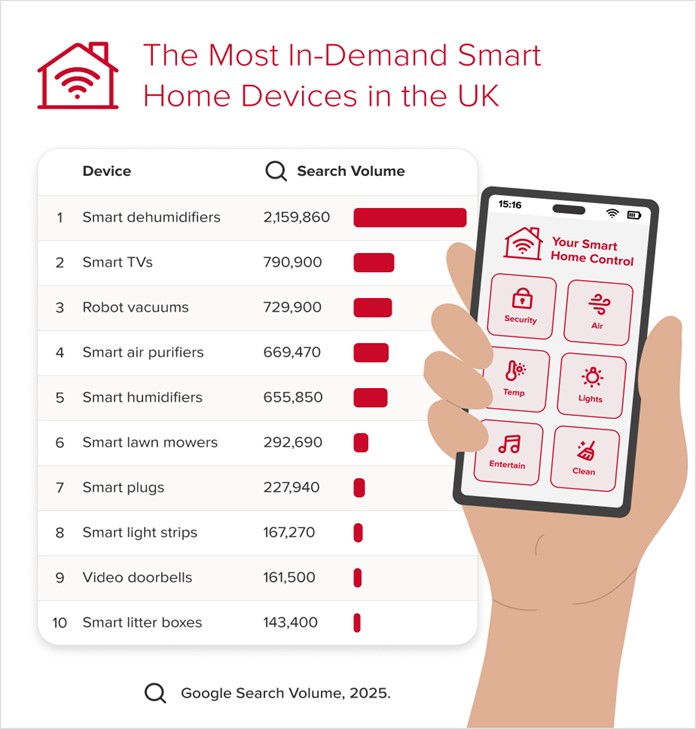
Looking at the most searched-for devices, clear themes emerge. They fall broadly into four categories: health and wellness, convenience, lifestyle and entertainment, and pet care.
Rather than chasing novelty, homeowners are searching for technology that improves comfort, saves time and supports healthier living environments.
But which smart home devices are on the up?
Search data also reveals which devices are gaining momentum, and where smart living is heading next.
Smart pet feeders have seen the biggest increase in searches in the past year (+56%), likely reflecting flexible working patterns and changing routines.
Devices offering practical automation and efficiency are also seeing strong growth. Homeowners are increasingly looking for solutions that integrate seamlessly into everyday life.
The top ten smart devices growing in demand are:
- Smart pet feeders (+55.56%)
- Multiroom speakers (+45.20%)
- Smart sprinklers (+36.54%)
- Smart curtain controllers (+28.77%)
- Smart microwaves (+26.39%)
- Robot mops (+24.83%)
- Smart blinds (+20.38%)
- Smart smoke alarms (+19.07%)
- Smart lawn mowers (+18.95%)
- Smart dryers (+16.33%)
This points towards a move away from single-function gadgets and towards connected ecosystems, where devices work together across the whole home.
Smart home priorities shift with the seasons
Our analysis shows that search behaviour changes throughout the year, reflecting how households adapt their homes to seasonal needs.
Spring favourites
Ahead of spring, homeowners begin preparing their homes for the coming months. Search interest rises for devices that support maintenance and wellbeing:
-
“Smart sprinkler” searches increased by 86%
-
“Smart lawn mower” searches increased by 40%
-
“Smart beds” searches increased by 34%
This seasonal shift reflects a desire to refresh and prepare, while using automation to reduce time spent on routine tasks.
Summer essentials
In the run up to summer, priorities are geared towards comfort in warmer conditions:
-
“Smart fans” increased by 272%
-
“Smart lawn mowers” increased by 189%
-
“Smart sprinklers” increased by 123%
Cooling devices and automated garden care help homeowners enjoy summer with fewer worries.
Winter warmers
As temperatures drop, attention turns to warmth and efficiency:
-
“Smart heaters” increased by 105%
-
“Smart dehumidifiers” increased by 70%
-
“Smart thermostats” increased by 55%
-
“Smart dryers” increased by 50%
These searches underline how smart technology supports comfort and energy efficiency during colder months, helping households stay warm while keeping running costs under control.
Where are the UK’s best connected homes?
Smart technology relies on a strong internet connection, but access to fast, reliable broadband isn’t equal across the UK.
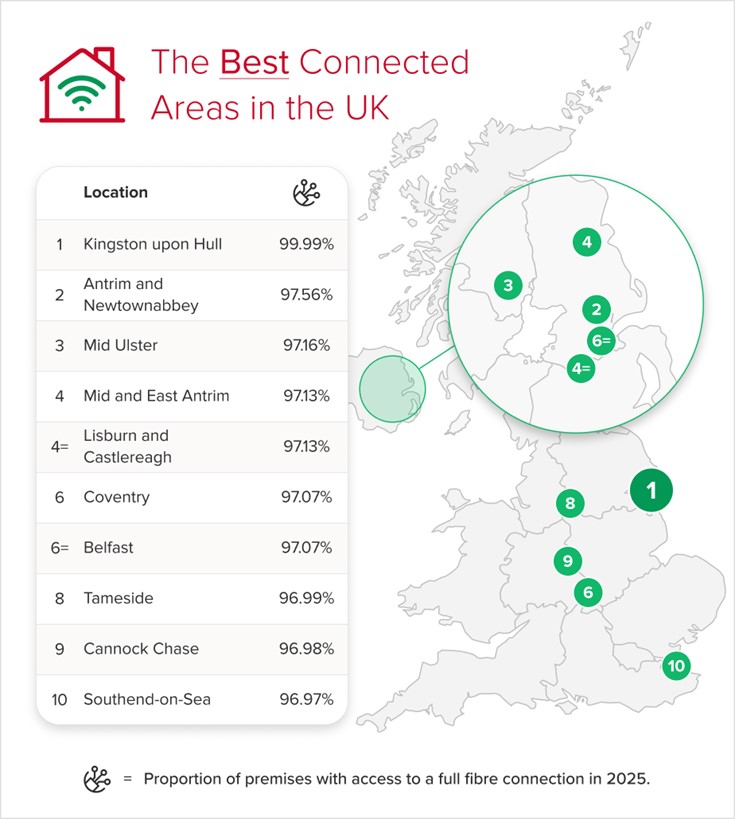
To understand where connected living is most accessible, we analysed thinkbroadband data to identify the best and worst connected areas for full-fibre broadband.
Kingston upon Hull tops the list as the most connected area, with 99.99% of homes having access to full fibre broadband. Antrim and Newtownabbey, and Mid Ulster also rank highly.
On the other hand, Na h-Eileanan Siar is the worst connected area in the UK; just 11.71% of homes have access to full fibre broadband. The Shetland Islands and the Orkney Islands have similarly low access.
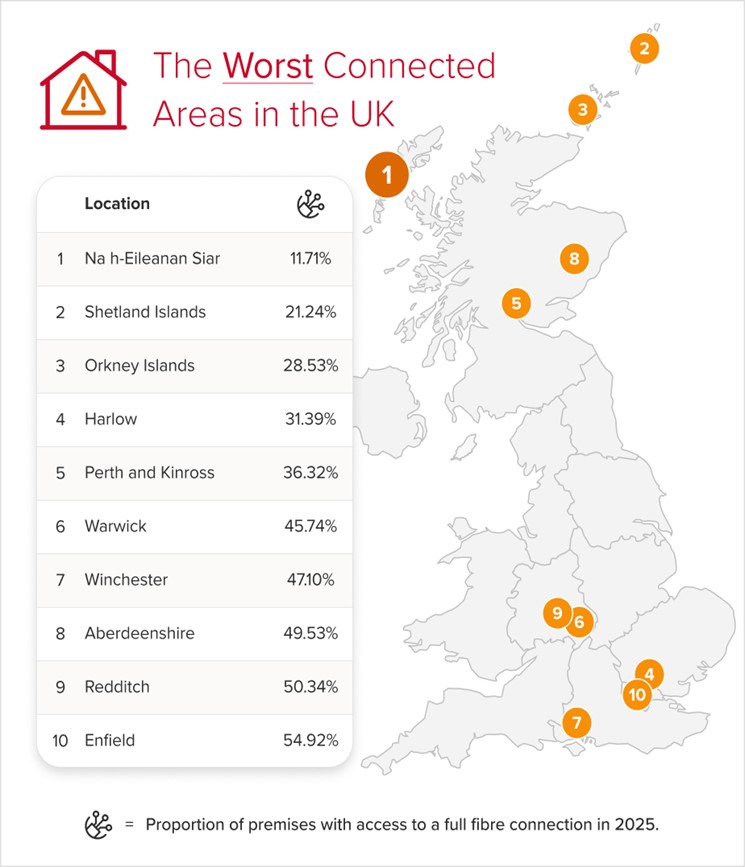
Areas with widespread full-fibre coverage are better equipped to support multiple smart devices at once. In contrast, areas with limited connectivity may face challenges when adopting more advanced smart technology.
This highlights the importance of future-proofed infrastructure, particularly in new build developments where connectivity can be designed in from the outset rather than retrofitted later.
At Redrow, all of our homes have ultrafast broadband as standard. Fibre optic cables are directly installed into your property, which means that the internet speed you can get in your home will be one of the best in the local area.
How to get started with smart technology
With so many devices available, getting started with smart technology can feel daunting. To help, we’ve created a simple five-step roadmap for homeowners considering connected living:
1. Identify your priorities
Start by focusing on areas where automation will have the biggest impact, such as energy efficiency, security or convenience.
2. Check your foundation
Reliable, high-speed broadband is essential. Redrow homes are equipped with new build broadband systems, supporting multiple devices without compromising performance.
3. Start small and expand
Begin with one or two devices and build gradually. This allows you to explore smart living at your own pace.
4. Personalise your setup
Tailor your home to your routine, whether that’s heating that switches on before you get home or lighting that adjusts throughout the day.
5. Consider lifestyle and sustainability
Smart technology can support accessibility needs, remote working and long-term sustainability goals, helping homes adapt as life changes.
Smart living in a Redrow home
Our homes are built for connected living. From energy-efficient design and full-fibre readiness to layouts that support modern lifestyles, Redrow homes provide a strong foundation for smart technology.
By combining thoughtful design with practical innovation, we’re helping homeowners discover a better way to live, where technology enhances everyday life without complicating it.
And for those already on the property ladder, the new build part exchange scheme or the assisted move scheme can make upgrading to a smart-ready new build simpler and more straightforward - helping homeowners focus on the benefits of their next home, rather than the complexity of the move.
Related Articles
-

Smart homes and technology
Nov 28, 2025
